
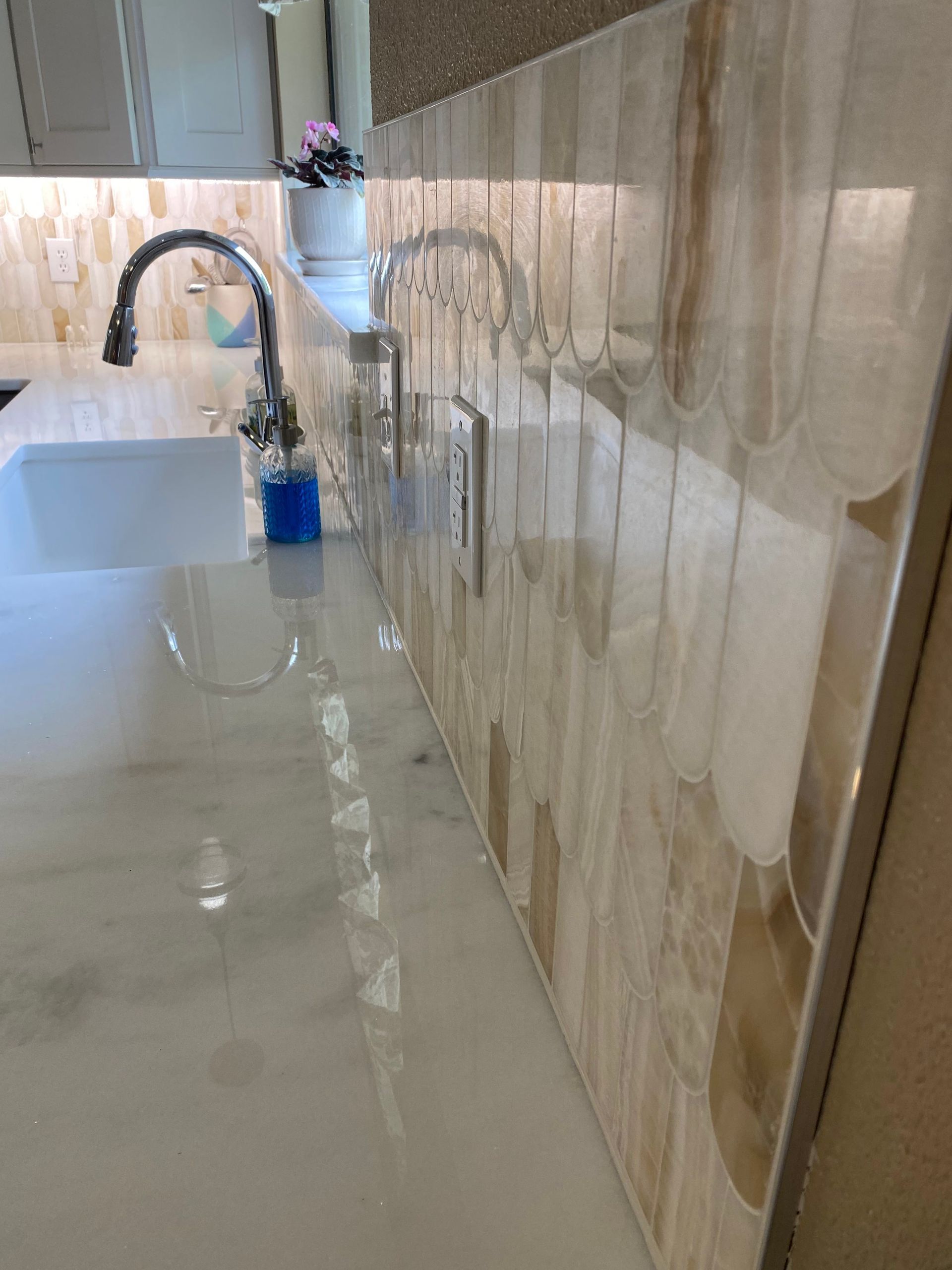
Surfaces That Handle Daily Kitchen Impact
Porcelain Slab & Custom Countertops in Mineola for kitchens requiring heat-resistant work surfaces and seamless visual continuity
Book-matched porcelain slabs create dramatic patterns where adjacent pieces mirror each other across seams, producing symmetrical veining that extends across islands and perimeter runs. Davenport Custom Remodeling fabricates and installs custom porcelain countertops, waterfall edges, and feature walls throughout Mineola, handling large-format slabs that require specialized equipment for cutting and positioning without fracturing. You work on surfaces that tolerate hot cookware placement directly from stovetops, resist staining from acidic foods without immediate cleanup, and maintain appearance through years of knife work and daily cleaning cycles.
Custom fabrication involves templating after cabinet installation to capture actual dimensions including any settling or alignment variations, then cutting slabs to fit exact layouts with cutouts positioned for sinks, cooktops, and faucet penetrations. Waterfall edges wrap vertically down island sides, requiring mitered joints where horizontal and vertical slabs meet at ninety-degree angles with pattern alignment across the seam. Precise installation ensures level surfaces without lippage between adjacent slab sections, which prevents water pooling and creates smooth transitions for sliding cookware across seams.
Request a consultation to review custom countertop layouts and select from available slab patterns for your project.
Why Large-Format Slab Installation Requires Specialized Handling
Porcelain slabs measuring up to ten feet in length arrive as single pieces, eliminating seams across standard countertop runs but requiring multiple installers and mechanical lifting equipment to position without cracking under their own weight during tilting and placement. Seam placement gets planned during templating to occur at sink cutouts or cooktop openings where breaks naturally occur, minimizing visible joints across continuous work surfaces. Davenport Custom Remodeling coordinates substrate preparation, ensuring cabinets sit level and provide adequate support before slabs arrive for final installation.
After installation completes, you notice uniform surfaces without the texture variation or pitting common in natural stone, edges finished to exact profiles without chipping that occurs when softer materials get fabricated, and pattern continuity across backsplashes that extends countertop designs vertically up walls. Waterfall edges create uninterrupted material flow from horizontal countertops down to floor level, particularly effective on islands viewed from multiple angles throughout open-concept spaces.
The service includes templating, custom fabrication to project specifications, delivery of finished slabs, and professional installation with seam alignment. Substrate preparation, cabinet leveling adjustments, and backsplash installation require separate coordination depending on project scope and existing conditions.
Common Questions About Slab Countertops
Homeowners evaluating porcelain slab options often ask about durability, maintenance requirements, and design considerations before committing to material selections.
What makes porcelain slabs different from quartz or granite countertops?
Porcelain forms through high-temperature pressing that creates uniform density without the resin binders used in engineered quartz, resulting in superior heat resistance that allows direct contact with hot cookware without surface damage. Unlike granite, porcelain requires no sealing and resists staining from oils and acids without absorption into the material.
How do fabricators achieve seamless joints on long countertop runs?
Seams get positioned where natural breaks occur in kitchen layouts—at sink cutouts or appliance openings—then polished and aligned so adjacent slab edges meet with minimal visible separation. Book-matching ensures patterns flow continuously across seams when vein orientation allows matching during layout planning.
Why do waterfall edges cost more than standard countertop installations?
Vertical slab sections require additional material since full-height pieces extend from countertop surface to floor, and mitered corner joints demand precise cutting to align patterns at ninety-degree turns. Installation complexity increases because vertical slabs need secure attachment methods that support weight without visible brackets interrupting the seamless appearance.
When do countertop seams become unavoidable even with large-format slabs?
Kitchen layouts exceeding ten feet in any direction require seams because slab dimensions max out at standard quarry cutting sizes. L-shaped and U-shaped counters always include at least one seam at the corner turn, positioned to minimize visual interruption while maintaining structural integrity at the joint.
What daily maintenance do porcelain countertops require in Mineola kitchens?
Standard cleaning with mild detergent and water keeps surfaces looking new without special products or periodic sealing treatments common with natural stone. Porcelain withstands the humidity fluctuations typical in East Texas without surface deterioration, moisture absorption, or finish degradation over time.
Davenport Custom Remodeling handles fabrication and installation for porcelain slab projects throughout the Greater Tyler Area, working with homeowners to select patterns and finishes that complement broader renovation goals. Arrange an estimate to explore slab options and discuss layout requirements specific to your kitchen design.